Costs:
The $45 billion project (originally $26 billion) was planned to process $200 billion worth of gas which would be piped from beneath the sea from the Browse Basin, 425 kilometres off the Kimberley coast. The gas would be shipped to Asia.
The chief executive of Perth-based Woodside and his team spent more than $1 billion on the design work for the James Price Point LNG project near Broome. (Nov 2012)
Location:
There were two location options for the gas hub:
Option A: North of Prices Point
The distance to the deep water jetty is greater and the land is higher. More blasting and dredging is required. (Public Information Booklet DSD page 13).
Option B: South of Prices Point
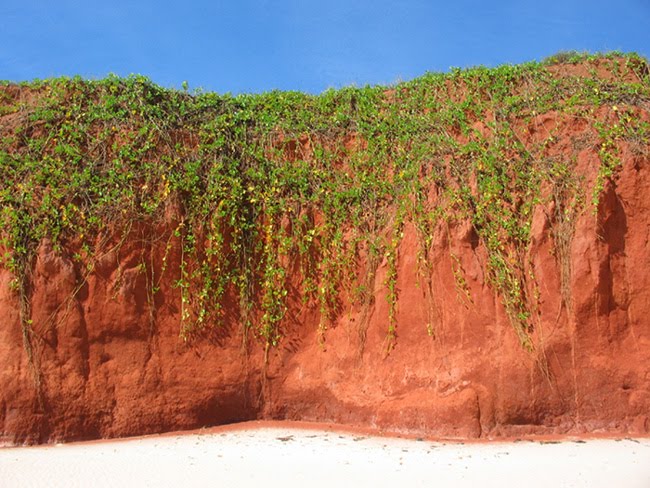
Shorter distance to deepwater and the land is lower. Impact to vine thickets.
Less blasting and dredging required.
Water Requirements:
The project required between 8-16 gigalitres annually (1 gigalitre = 1 billion litres) for the whole precinct. Broome is currently licensed for 8 gigalitres and uses 6 gigalitres annually. Fresh water is likely to come from either desalination of water from the Wallal aquifer or desalination of sea water. The Wallal aquifer is located 200 metres below the ground and is slightly salty. This aquifer is separate to the shallower Broome aquifer that is suitable for drinking.
During construction it is possible that a temporary water supply will be required. It is likely this will be from the Broome aquifer. (Page 75 Public Information Booklet DSD).
Wastewater:
30GL/year wastewater - (process waste water, ancillary equipment such ascondensed water, surface runoff from process areas, sewage and grey water. (Page 12 Marine Wastewater Discharge Modelling Study DHI WATER AND ENVIRONMENT PTY LTD for Woodside).
The treated wastewater will be discharged 2 to 3 kilometres off shore and according to the Public Information booklet DSD page 74 "the discharge poses negligible if any environmental risk."
Shipping:
Overall capacity of 50 million tonnes per year of LNG would mean 900 ships per year or 17 per week or just over 2 per day (Public Information Booklet DSD page 69).
Workers:Peak construction workforce: 6000 on shore and 2000 offshore (Broome Advertiser page 9 August 18th).
Core workforce: 300 - 500 people for 40 years.
The vaste majority of the construction workforce is likely to be fly-in, fly-out and accommodated with a dedicated camp 5 km from the Coast. (Public Information Booklet DSD page 89)
Workers will probably do a 4 week on 1 week off roster. During the 4 week on period they could work 6 and a half days per week. Organised trips into Broome for shopping, recreation and tourism activities could be organized for the half day off. The many other people who support the village will not be tied to this construction roster and may have other arrangements including the possibility of being local residents of Broome who drive in drive out.
During construction of the Gas facility an extra $350 million expenditure for local business is planned, this does not include the proportion of wages etc that will also flow into the local economy. During the production phases this will drop to around $100 million p.a.
On 07 January 2013 Planning Solutions $Aust$ Pty Ltd behalf of Decmil Group Ltd in partnership with Nyimarr Ltd lodged an application for planning approval to develop an 857 person temporary Transient Workers’ Accommodation on Lot 283 Broome Road Roebuck
Size:The proposed gas hub was the largest in Australia, the second largest in the world and at least 3 times the size of the Karratha LNG plant. ($45 billion project)
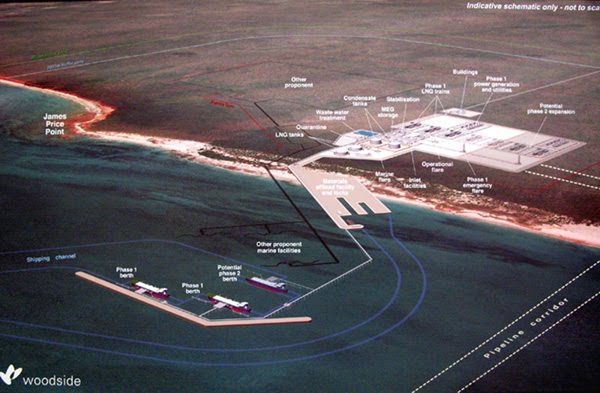
2,500 hectares (25 square kilometres) of land (1980 hectares = LNG Processing area + Port land 110 hectares + 200 hectares Light Industrial area) and about 1,000 hectares (10 square kilometres) of sea bed which includes 2 kilometres of coastline. A further 968 hectares of land (10 square kilometres) will be used for the "ancillary' areas of onshore pipelines roads and service.
"The site will be set back 1.5 kilometres from the coast and beach access restrictions will be limited to less than 2 kilometres of coastline." (Shire News Issue 61 August 2011).
"Access to Prices Point and Quandong Point will be maintained throughout the life of the Precinct." (Shire New Issue 61 August 2011).
Jetty: The proposed jetty was 'L shaped' and 2 kilometres in length.
It was to project 1.5 kilometres into the ocean. The breakwater ran parallel to the coast and 1 kilometre from the shoreline.
Greenhouse gas emissions:
"In producing LNG there are two major sources of carbon dioxide (CO2) which is the main greenhouse gas.
The first major source of greenhouse gas emissions relates to the generation of power.
Power is generated in a similar way to a gas fired power station like the one in Broome,
but larger. The exact amount of CO2 will depend on the design of the LNG plant but
would be less than 17 million tonnes of CO2 per annum for the production of 50 million tonnes of LNG per annum"
"The second major source of CO2 comes from the reservoir. This
results in approximately 15 million tonnes of CO2 per annum for 50 million tonnes of LNG per annum. Typically this 'reservoir CO2' will be vented to the atmosphere.
Woodside is investigating the option of reinjecting this CO2 back into a safe underground
formation where the gas will be trapped.
The plant will be designed to meet atmospheric emissions and discharge limits which
protect the health and safety of the community and protect the natural environment. This
will be a requirement of obtaining environmental approval and operating licences which
must be in place prior to the commencement of construction." Public Information Booklet page 82
The $33 billion INPEX liquefied natural gas project in Darwin is expected to increase greenhouse gas emissions in the Northern Territory by 30 per cent and Australian emissions by 1.3%.
Stuart Blanch from the Northern Territory Environment Centre says the project is expected to generate 280 million tonnes of emissions over 40 years.
Production is not expected to begin until 2016 a spokeswoman from Inpex says the company is still assessing greenhouse gas abatement options. (source AM 16th Jan 2012)
Dredging:
"Preliminary estimates indicate a total dredging volume for a southern James Price Point
site to be in the order of
6 to 8 million cubic metres or less than half the volume of the
northern site.
Total dredging volume for a northern James Price Point location would be approximately
15 to 20 million cubic metres". (DSD Information booklet 5.4)
A Federal Government review of Woodside’s planned dredging program at James Price Point has revealed serious concerns about the potential impact on the marine environment from toxins, including arsenic and zinc.
The Federal Department of Sustainability, Environment, Water, Population and Communities review was obtained through a Freedom of Information request by the Wilderness Society.
The 2011 Federal review considered the Department of State Development’s revised coastal modelling work done after it delivered the Browse strategic assessment report, in December 2010.
The 2011 review found several deficiencies in the earlier assessment.
Reviewers were concerned that the assessment had failed to address the potential for dredging to release arsenic, nickel and zinc into the water.
While all occur naturally in the environment, at high concentrations they can be toxic to marine invertebrates and phytoplankton – a major concern for aquaculture and fishing industries in the region.
April 5th 2012
Problems facing project:
"Technical difficulties, very high CO2 content with no abatement plans, environmental and heritage hurdles to jump, joint venture partner reluctance as well as significant local community opposition in Broome which is spreading through the country." (Environs Kimberley Jan 27th 2012).
Pipe it ? (unlikely! Nov 2012)
The field is considered too far from shore for it to be economically viable to build a pipeline.
Author: ANDREW BURRELL, RESOURCES
Publication: The Australian, Page 27 (Thu 20 Sep 2012)
THE cost of building the Woodside Petroleum-led Browse gas project on a greenfields site in the Kimberley has soared to $US45 billion ($43.08bn), but the developers would save only $2bn by piping the gas to the North West Shelf in the Pilbara, according to a major report by JPMorgan.
In the first analysis of its kind, the bank said it understood from talks with Woodside that the three LNG processing units, or trains, at the 25-year-old North West Shelf facility would need to be largely rebuilt if they were to process the Browse gas.
Combined with the cost of building a pipeline hundreds of kilometres from the Browse Basin, the North West Shelf option could be just 5 per cent cheaper than James Price Point, it found. If the calculations are correct, Woodside and its Browse partners would be considered more likely to push ahead with its preferred development plan of building an LNG plant at James Price Point, 60km north of the tourist town of Broome. That option is heavily backed by the WA and federal governments, but the plan has attracted strong opposition from environmentalists, traditional owners and some of the Broome community.
Despite this, JPMorgan said it remained of the view that the Browse gas was most likely to be developed at the North West Shelf. This was largely due to the vehement opposition to the Kimberley plan, which was ``unwavering, increasingly organised and gathering momentum''.
JPMorgan revised its capital spending estimates for Browse, calculating that the cost of building at James Price Point had risen from $US26.3bn to $US44.6bn.
"Broomenogas community update in the Broome Advertiser claimed that Citigroup said it is now $15 billion cheaper to pipe gas to the Pilbara and the return on investment is 15.3% compared to 11.3% at JPP." September 27th 2012.
David Hewitt, co-head of global oil and gas for Credit Suisse, is sceptical about the view that FLNG will be cheaper than James Price Point and says the most likely development option for Browse is for the gas to be piped -- several years from now -- to existing LNG facilities in the Pilbara. (Dec 2012)
Timetable.
2011 Geotechnical survey work at JPP
Social Impact Assessment
Complete FEED, Front End Engineering and Design
State and Commonwealth Environment Approvals
2012 Social Impact Management Plan finalised
EPC Contract awarded.
EPA approves future work at JPP - July 16th 2012
State Minister approval - 30th October 2012
Federal Minister approval ???
Final investment decision first half of 2013. The WA and Federal governments approved a request by Woodside Petroleum and its four Browse LNG project partners to delay making a development decision for the controversial venture by up to one year.
It is estimated that over the past 12 months (2010/2011) Woodside have spent $20mill at over 100 businesses in Broome. This amount does not include sub contracting arrangements or flow on effects
22nd August 2012 Chevron sells to Shell now 27% in Browse
BHP Billiton is selling its 9.1% ownership to PetroChina. (12th Dec 2012).
BHP did not back floating the gas or building a gas hub at Prices Point. (Nov 30th 2012)
Float it?
Floating the gas is early technology and BHP Billiton claim it is untested despite recent advances. (Nov 2012)
"THE Woodside Petroleum-led Browse joint venture would save $9 billion in capital costs by developing the project using floating liquefied natural gas technology rather than building a gas plant on the Kimberley coast, according to a report by investment bank JPMorgan.
The first in-depth analysis of the increasingly likely FLNG option estimates it would cost the Browse partners $US35.5bn ($34.3bn) compared with an estimated $US44.6bn to build an onshore plant at James Price Point." (November 2012)
Shell is believed to be pushing its Browse partners to consider the floating technology. (Nov 2012)
- A floating platform offshore greatly reduces the cost associated with onshore processing, and it could be an option for all offshore projects in WA. (Nov 2012)
- Past environmental disasters were not connected to floating gas processing technology. (Nov 2012)
However, at this stage, gas from the Browse project is locked into being processed at James Price Point.
Woodside simply has to comply with the retention lease terms so it's James Price Point for Browse right now," (Nov 2012.
"October 2012 - a giant shipyard on the South Korean island of Geoje, an event occurred that seems likely to forever change the face of Australia's booming liquefied natural gas industry.
It was then that the first steel for Royal Dutch Shell's gargantuan Prelude floating LNG facility was cut at the Samsung Heavy Industries factory, marking the start of construction of a vessel that is a genuine world first.
When completed in 2016, Prelude will be 488m long and 74m wide and will weigh more than 600,000 tonnes.
The revolutionary FLNG vessel -- the first of many Shell says it is planning to build -- will be towed from South Korea to a location about 200km from Western Australia's Kimberley coast, smack bang in the middle of the highly prospective Browse Basin.
Prelude will process the rich hydrocarbons from the Prelude field into LNG and the finished product will then be loaded on to tankers for export to markets around the world.
The Browse gasfields -- known as Torosa, Brecknock and Calliance -- are located in the Browse Basin, about 100km south of Prelude.
The fields boast about 15 trillion cubic feet of gas -- far more than Prelude's 3 trillion cubic feet
Woodside to deliver its mandated study on the onshore KImberley LNG plant in June to the six joint venture partners, who also include BP, Mitsubishi and Mitsui.
Each joint venture partner will then have to make a decision about whether the economics of the project stacks up. (Nov 2012)
THE DECISION!!
In the end it could all come down to economics for the venture partners - low world wide gas prices, competition from other countries, cost blow outs etc.
Who owns the gas in the Browse Basin - the State of WA, the Commonwealth Government or both?
Both – it has yet to be decided what share WA will get, the Premier has quoted 30%
Can the Premier stop the Venture Partners floating the gas from the Browse Basin or can the Federal Government over ride the State Government?
It would have to be a joint decision with the Commonwealth
What happens if the Venture Partners decide to delay the option of drilling for gas in the Browse Basin?
They would have to show why it is economically unviable at JPP
If the gas is floated from the Browse Basin will the Commonwealth Government receive all the royalites that the State Governement of WA will get?
No - WA will get the same share
Colin Barnett has said that he will force the Venure Partners to opt for Prices Point - what happens if they decide not too?
If they can show it is unviable economically they will have fulfilled their retention lease conditions, theoretically they would then start again with viable options.


 The movers and shakers: